

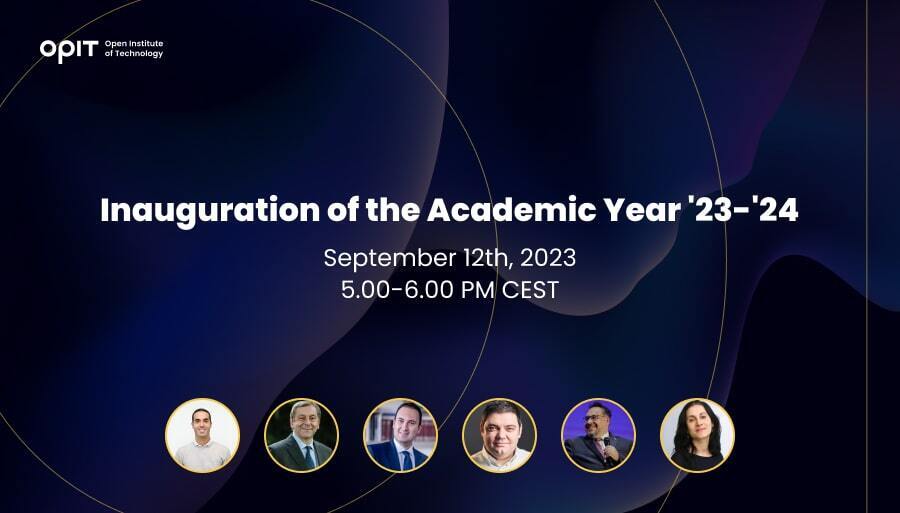
With immense pride and anticipation, we announce the inaugural event for the OPIT – Open Institute of Technology academic year. As pioneers in the new era of Higher Education, this event encapsulates the very ethos of what OPIT represents. Not just an event, but the commencement of a journey to pave the way for the next generation of leaders in the field of IT.
Event Details
- Date: September 12th, 2023
- Time: 5.00-6.00 PM CEST
- Platform: Online
- Registration: Link
Event Schedule
- Official Introduction: Mr. Riccardo Ocleppo, the founder of OPIT, paints a picture of the Institution’s foundational pillars and what prospective students can expect from their academic journey.
- Learning Model Presentation: Prof. Francesco Profumo, our esteemed Rector, delves deep into the heart of OPIT’s avant-garde learning experience, shedding light on its core tenets and alignment with the demands of the contemporary job market.
- Accreditation and Quality Assurance: The Malta Minister of Education, Dr. Clifton Grima, offers insights into the robust educational framework of Malta and the stringent quality assurance measures in place.
- The Future of Jobs in the Era of AI: Prof. Alexiei Dingli navigates the evolving terrains of the job market under the shadow of AI’s relentless march, emphasizing the pivotal role of institutions like OPIT.
- The Impact of Digitalization on a Global Scale: Dr. Bernardo Calzadilla Sarmiento, former Managing Director of UNIDO (United Nations Industrial Development Organization) offers a panoramic view of the digital revolution sweeping across the globe and its profound implications on industry, economy, and education.
- Q&A Session: Led by Greta Maiocchi, the Head of Admissions at OPIT, this segment is dedicated to addressing queries, clearing doubts, and facilitating an open dialogue.
In a world where AI and digital innovation are reshaping boundaries, institutions like OPIT emerge as guiding lights. Join us at this pivotal juncture as we navigate the AI-driven future, fortified by our dedication to education, foresight, and ambition.
Join us in marking the beginning of an era. Let’s shape the future, together.
Register here for the event.
-
From the same author
 Read the article
Artificial Intelligence (AI) is reshaping the cybersecurity landscape, and not just for the better. While AI-powered security solutions are proving effective at detecting and preventing cyberattacks and malicious programs, agentic AI is also being embraced by bad actors and hacking groups to make their attacks potentially more effective and dangerous.
Quick Summary
- AI technology is taking an increasingly active role in cyber-attacks today.
- It can identify targets, bypass protections, harvest credentials, and steal data autonomously.
- Attacks are likely to become more sophisticated and complex as AI gets smarter.
- The coming years will see swarm attacks, deepfake-as-a-service technology, and other new threats.
- Those wishing to help entities defend themselves can consider an MSc in Cybersecurity at OPIT.
The Age of Autonomous Cybercrime
Autonomous cybercrime isn’t a theory or a prospective threat on the horizon; it’s an active danger, threatening businesses, governments, and individuals across the globe today. Where cyberattacks may have once involved months of planning and manual work, some attacks can now be planned and executed much faster, with significantly less human involvement.
AI can carry out reconnaissance to identify and map targets autonomously, potentially much faster than human attackers working manually. It can also be used to bypass some defensive systems, steal login details, and automate parts of an attack before conventional defenses can start to respond.
This danger is becoming more widespread, with a Signicat report finding a 2,137% increase in deepfake fraud attempts over the previous three years. The report also found that 42.5% of detected fraud attempts in the financial and payments sector involved AI.
A New Era of Cybersecurity
Before AI emerged, cybercriminals regularly developed new tools and techniques to deceive their victims, steal data, and cause chaos in cyberspace. But almost all of their attacks were manually driven. They had to do most of the hard work and heavy lifting, which effectively limited the speed, efficiency, and overall risk level of their attacks.
Now that AI has entered the equation, experts feel that the “Manual Phase” of cybersecurity is all but over, with two new phases emerging from 2022 onwards:
- The Generative AI Phase: Beginning around 2022, this was when attackers increasingly experimented with generative AI technologies to streamline and enhance their campaigns.
- The Autonomous Phase: From 2025 onwards, the autonomous phase involves AI not merely helping attackers, but effectively replacing them. The latest agentic models can do far more than write scam messages or generate malware; they can orchestrate complex, multi-stage attacks, at scale, while human attackers sit back and wait for the results.
The PRAR Loop
Many analysts fear that this new phase of cybersecurity could quickly spiral out of control because of AI’s propensity to become smarter and more effective at carrying out its duties as time goes by. They cite the “PRAR Loop” as the mechanism that cybersecurity businesses and at-risk entities need to be aware of from this point on:
- Perceive: The AI reads and understands its environment.
- Reason: It relies on its own training and data access to plan its next step.
- Act: It puts its plans into action, rapidly and without need for human oversight or instruction.
- Reflect: It reviews the impact of its actions and uses the results to adjust subsequent actions or plans.
This is what makes AI-powered cyber-attacks so concerning. Unlike traditional malware, which generally requires attackers to modify or redeploy it, AI-powered systems can adapt their behavior and automate iterative tasks without requiring a human to direct every step.
The Five Stages of an AI Attack
While individual attacks can vary widely in their planning and execution, a typical deepfake strike might include the following five stages:
- Reconnaissance: This is the point at which the AI identifies its target and learns as much about it as possible, often using publicly accessible data, like company websites, social media profiles, and press releases.
- Construction: Again relying on publicly available data, such as videos and audio files, the AI can construct a realistic likeness of a figure of authority within the business, such as the Chief Financial Officer (CFO).
- Approach: The deepfake is deployed, either in video or audio form. The attacker uses the AI-generated imitation of a real business figure to demand that a lower-level employee take some sort of action, like transferring money or sharing files.
- Verification: This is the stage at which attacks may be thwarted, but it depends on whether an employee takes the time to verify the deepfake figure’s identity. If they don’t, the attack will almost invariably succeed. If they do, they may realize what’s happening and take action to stop it.
- Result: Again, depending on what happened in the previous stage, the attack may either succeed or fail. If it succeeds, data, funds, and credentials may all be lost or stolen.
Looking Ahead
By 2027, some experts and forecasts anticipate that AI-powered cybercrime could evolve significantly, potentially enabling malicious groups to deploy coordinated, multi-agent attacks and assisting attackers in identifying vulnerabilities and developing exploits.
At the same time, there are people on the other side of the equation using AI to build better defenses and guard against these kinds of attacks, and working to level the playing field.
These “guardians of tomorrow” are already learning the tools of their trade today on courses like OPIT’s Master’s Degree (MSc) in Enterprise Cybersecurity, which provides graduates with the technical and managerial expertise they need to develop new security solutions and lead bold cybersecurity initiatives.
Key Takeaways
- AI-powered cyber-attacks are likely to get more dangerous in the years ahead.
- Current attacks often revolve around deepfakes or AI-generated exploits, but new methods are likely to emerge.
- It will be up to cybersecurity students, graduates, and experts to lead the counter-charge and develop AI-powered defenses to stop these attacks before they do damage.
Learn How to Safeguard the Systems of Tomorrow at OPIT
If you’re concerned about the rapid rise of AI-powered cybercrime and would like to play a part in stopping it, you might like to consider signing up for the MSc in Enterprise Cybersecurity at OPIT. It will give you the tools you need to build the stronger, smarter defenses that businesses are going to need to protect themselves from AI threats for years to come. Visit the OPIT site to learn more or fill out an application.
-

 Go to all authors


Related posts

Artificial Intelligence (AI) is reshaping the cybersecurity landscape, and not just for the better. While AI-powered security solutions are proving effective at detecting and preventing cyberattacks and malicious programs, agentic AI is also being embraced by bad actors and hacking groups to make their attacks potentially more effective and dangerous.
Quick Summary
- AI technology is taking an increasingly active role in cyber-attacks today.
- It can identify targets, bypass protections, harvest credentials, and steal data autonomously.
- Attacks are likely to become more sophisticated and complex as AI gets smarter.
- The coming years will see swarm attacks, deepfake-as-a-service technology, and other new threats.
- Those wishing to help entities defend themselves can consider an MSc in Cybersecurity at OPIT.
The Age of Autonomous Cybercrime
Autonomous cybercrime isn’t a theory or a prospective threat on the horizon; it’s an active danger, threatening businesses, governments, and individuals across the globe today. Where cyberattacks may have once involved months of planning and manual work, some attacks can now be planned and executed much faster, with significantly less human involvement.
AI can carry out reconnaissance to identify and map targets autonomously, potentially much faster than human attackers working manually. It can also be used to bypass some defensive systems, steal login details, and automate parts of an attack before conventional defenses can start to respond.
This danger is becoming more widespread, with a Signicat report finding a 2,137% increase in deepfake fraud attempts over the previous three years. The report also found that 42.5% of detected fraud attempts in the financial and payments sector involved AI.
A New Era of Cybersecurity
Before AI emerged, cybercriminals regularly developed new tools and techniques to deceive their victims, steal data, and cause chaos in cyberspace. But almost all of their attacks were manually driven. They had to do most of the hard work and heavy lifting, which effectively limited the speed, efficiency, and overall risk level of their attacks.
Now that AI has entered the equation, experts feel that the “Manual Phase” of cybersecurity is all but over, with two new phases emerging from 2022 onwards:
- The Generative AI Phase: Beginning around 2022, this was when attackers increasingly experimented with generative AI technologies to streamline and enhance their campaigns.
- The Autonomous Phase: From 2025 onwards, the autonomous phase involves AI not merely helping attackers, but effectively replacing them. The latest agentic models can do far more than write scam messages or generate malware; they can orchestrate complex, multi-stage attacks, at scale, while human attackers sit back and wait for the results.
The PRAR Loop
Many analysts fear that this new phase of cybersecurity could quickly spiral out of control because of AI’s propensity to become smarter and more effective at carrying out its duties as time goes by. They cite the “PRAR Loop” as the mechanism that cybersecurity businesses and at-risk entities need to be aware of from this point on:
- Perceive: The AI reads and understands its environment.
- Reason: It relies on its own training and data access to plan its next step.
- Act: It puts its plans into action, rapidly and without need for human oversight or instruction.
- Reflect: It reviews the impact of its actions and uses the results to adjust subsequent actions or plans.
This is what makes AI-powered cyber-attacks so concerning. Unlike traditional malware, which generally requires attackers to modify or redeploy it, AI-powered systems can adapt their behavior and automate iterative tasks without requiring a human to direct every step.
The Five Stages of an AI Attack
While individual attacks can vary widely in their planning and execution, a typical deepfake strike might include the following five stages:
- Reconnaissance: This is the point at which the AI identifies its target and learns as much about it as possible, often using publicly accessible data, like company websites, social media profiles, and press releases.
- Construction: Again relying on publicly available data, such as videos and audio files, the AI can construct a realistic likeness of a figure of authority within the business, such as the Chief Financial Officer (CFO).
- Approach: The deepfake is deployed, either in video or audio form. The attacker uses the AI-generated imitation of a real business figure to demand that a lower-level employee take some sort of action, like transferring money or sharing files.
- Verification: This is the stage at which attacks may be thwarted, but it depends on whether an employee takes the time to verify the deepfake figure’s identity. If they don’t, the attack will almost invariably succeed. If they do, they may realize what’s happening and take action to stop it.
- Result: Again, depending on what happened in the previous stage, the attack may either succeed or fail. If it succeeds, data, funds, and credentials may all be lost or stolen.
Looking Ahead
By 2027, some experts and forecasts anticipate that AI-powered cybercrime could evolve significantly, potentially enabling malicious groups to deploy coordinated, multi-agent attacks and assisting attackers in identifying vulnerabilities and developing exploits.
At the same time, there are people on the other side of the equation using AI to build better defenses and guard against these kinds of attacks, and working to level the playing field.
These “guardians of tomorrow” are already learning the tools of their trade today on courses like OPIT’s Master’s Degree (MSc) in Enterprise Cybersecurity, which provides graduates with the technical and managerial expertise they need to develop new security solutions and lead bold cybersecurity initiatives.
Key Takeaways
- AI-powered cyber-attacks are likely to get more dangerous in the years ahead.
- Current attacks often revolve around deepfakes or AI-generated exploits, but new methods are likely to emerge.
- It will be up to cybersecurity students, graduates, and experts to lead the counter-charge and develop AI-powered defenses to stop these attacks before they do damage.
Learn How to Safeguard the Systems of Tomorrow at OPIT
If you’re concerned about the rapid rise of AI-powered cybercrime and would like to play a part in stopping it, you might like to consider signing up for the MSc in Enterprise Cybersecurity at OPIT. It will give you the tools you need to build the stronger, smarter defenses that businesses are going to need to protect themselves from AI threats for years to come. Visit the OPIT site to learn more or fill out an application.
Source:
- Forbes, published on August 11th, 2026
By Gary Drenik
In a difficult business environment, artificial intelligence can look like an obvious answer for executives seeking faster work, lower costs and new efficiencies. But as AI moves into everyday business use, the more important question is whether those gains will last.
New research led by Professor Jan-Emmanuel De Neve of Saïd Business School, University of Oxford suggests companies may be making a strategic mistake if they treat AI mainly to cut headcount. The research argues that businesses focused too heavily on automation risk weakening the human capabilities they will need for growth, including creativity, judgment, institutional knowledge and leadership development.
“It’s a classic manifestation of status quo bias,” says De Neve. “It’s far easier for an executive to look at a spreadsheet and imagine using AI to streamline what people already do than it is to do the heavy strategic lifting of reimagining how technology can produce entirely new value. Treating AI as a headcount-slashing tool might yield quick, visible cost savings, but it is ultimately a path of organisational contraction that trades away a company’s long-term capacity to innovate.”
The distinction is central to AI strategy. Automation replaces tasks people currently perform. Augmentation expands what people can do, giving employees more capacity for problem solving, customer relationships and higher-value decisions.
A recent survey from my company Prosper Insights & Analytics shows why this matters. In its survey of U.S. adults, Executives and Business Owners were more likely than Employees to say they already use generative AI, at 53% compared with 38%. That suggests leaders may be closer to the strategic promise of AI, while employees are closer to the disruption it creates in daily work.
Prosper Insights & Analytics also found that 31% of employees are concerned AI will cause job losses, while 11% are concerned they personally will lose their job because of AI. A further 25% of employees say they do not trust that AI has their best interests in mind.
Those figures matter because AI adoption is also a trust exercise. If employees believe AI is being introduced to make them easier to replace, they are less likely to experiment with it openly, challenge its outputs or show managers where it can improve the business.
Professor Ashish Kumar from Trinity Business School calls this “an agency and incentive problem.” Senior leaders often see AI through the lens of strategy, efficiency and long-term opportunity, while employees deal with the practical consequences when new tools disrupt existing workflows. Kumar argues that workers are more likely to embrace AI when they feel involved in the decision, understand how it will help them, and trust that the technology is being introduced to support their work rather than threaten it.
De Neve argues that augmentation creates a different relationship between workers and AI. “When you choose augmentation, you unlock a compounding growth cycle. Employees engage with curiosity and agency, becoming ‘pilots’ of the technology rather than passive passengers.”
The danger of an automation-first approach is especially clear when companies reduce junior hiring or cut entry-level roles. These roles are often viewed as easy to automate because they involve repeatable tasks, basic analysis or administrative work. Yet they are also where future leaders learn judgment, build relationships and understand clients.
“When you cut human compensation and junior roles to fund technology, you hollow out your internal leadership pipeline and destroy the psychological safety required to innovate,” says De Neve. “The AI revolution will not be won by the organisations that replace people the fastest, but by those that empower them the best.”
The issue is not whether companies should ignore efficiency, it is whether efficiency becomes the whole strategy. Professor Guillaume Coqueret of Emlyon business school argues that AI adoption depends on both individual adaptability and organisational factors including leadership, incentives, culture and the choice of tools. Legacy organisations face a harder challenge because AI often has to be introduced into older processes, established habits and uneven levels of confidence.
That alignment also affects quality. One emerging risk is “workslop,” AI-generated content that looks useful but lacks the substance needed to move work forward. Alan Lerner, professor at the Open Institute of Technology – OPIT, describes workslop as “AI generated work content that masquerades as good work, but lacks the substance to meaningfully advance a given task.”
The danger is that AI increases output volume while shifting the burden onto employees who must check and interpret unclear work, creating the impression of productivity while increasing the effort needed to make AI output reliable.
Prosper Insights & Analytics data points to similar concerns. Among employees surveyed, 37% say AI needs human oversight, while 34% are concerned it can provide wrong information or hallucinations. These responses suggest many employees are not rejecting AI. They understand that its value depends on human judgment.
That judgment is harder to sustain when employees are anxious, overloaded or unsure how their work is being evaluated. Debora Nozza, Assistant Professor at Bocconi University, says AI can reduce some tasks while increasing the mental burden around others.
“In theory, AI should reduce the burden of work. In practice, it often changes the nature of that burden,” says Nozza.
Prosper Insights & Analytics also found that 17% of employees say AI makes them anxious. That does not mean AI adoption should slow, but companies need to pay closer attention to morale, training, communication and workload. If AI leaves employees less able to apply their judgment, the expected efficiency gains may prove smaller than leaders hoped.
The most successful AI strategies will likely be judged by more than adoption rates or cost savings. Companies will need to ask whether AI is improving work quality, helping employees make better decisions, strengthening retention and building the next generation of leaders.
Automation can make old processes faster. Augmentation can help companies develop new sources of value. Companies that recognise this may be better placed to turn AI from a short-term efficiency tool into a lasting source of competitive advantage.
Read full article here: Forbes
Have questions?
Visit our FAQ page or get in touch with us!

Write us at +39 335 576 0263

Get in touch at hello@opit.com

Talk to one of our Study Advisors

We are international
We can speak in:


